
Ghost Controls Gate Repair in Redlands: A Homeowner’s Guide
A Ghost Controls gate that quits in January usually isn’t broken – it’s hungry. These systems run on solar-charged batteries, and Redlands’ shorter winter days mean fewer usable charging hours, which drops battery voltage low enough to mimic a dead motor. The fix is often a recharge or a panel reposition, not a new operator. That’s the core of Ghost Controls repair: knowing whether the problem is power, programming, or mechanical before you spend money on the wrong part. If you’d rather not sort it out yourself, call (844) 405-5765 and we’ll diagnose it properly.
How Ghost Controls Systems Actually Work
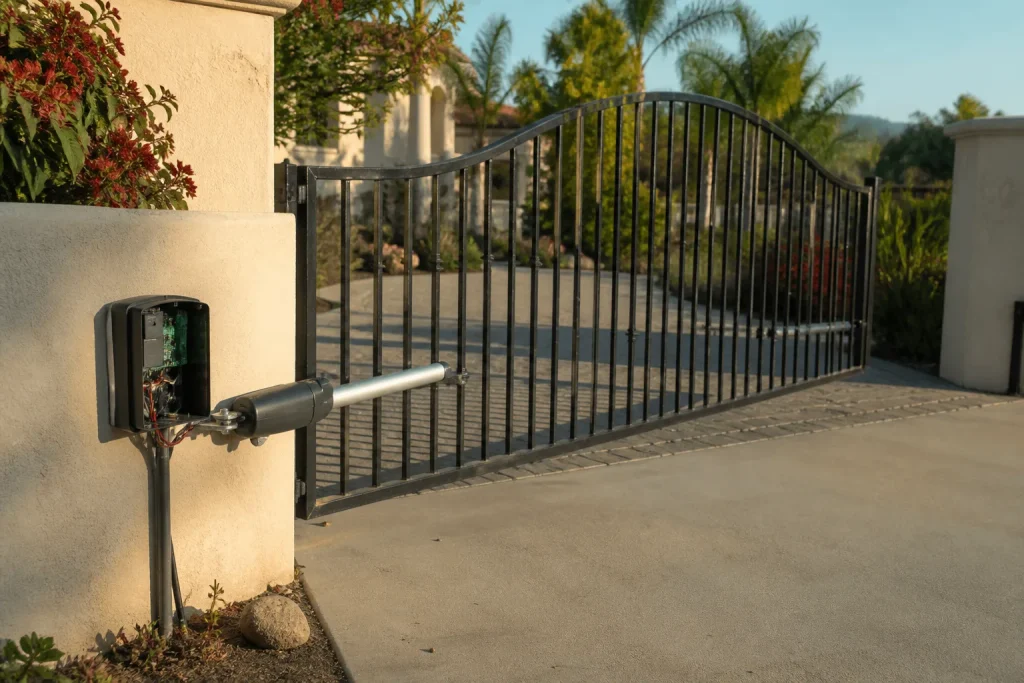
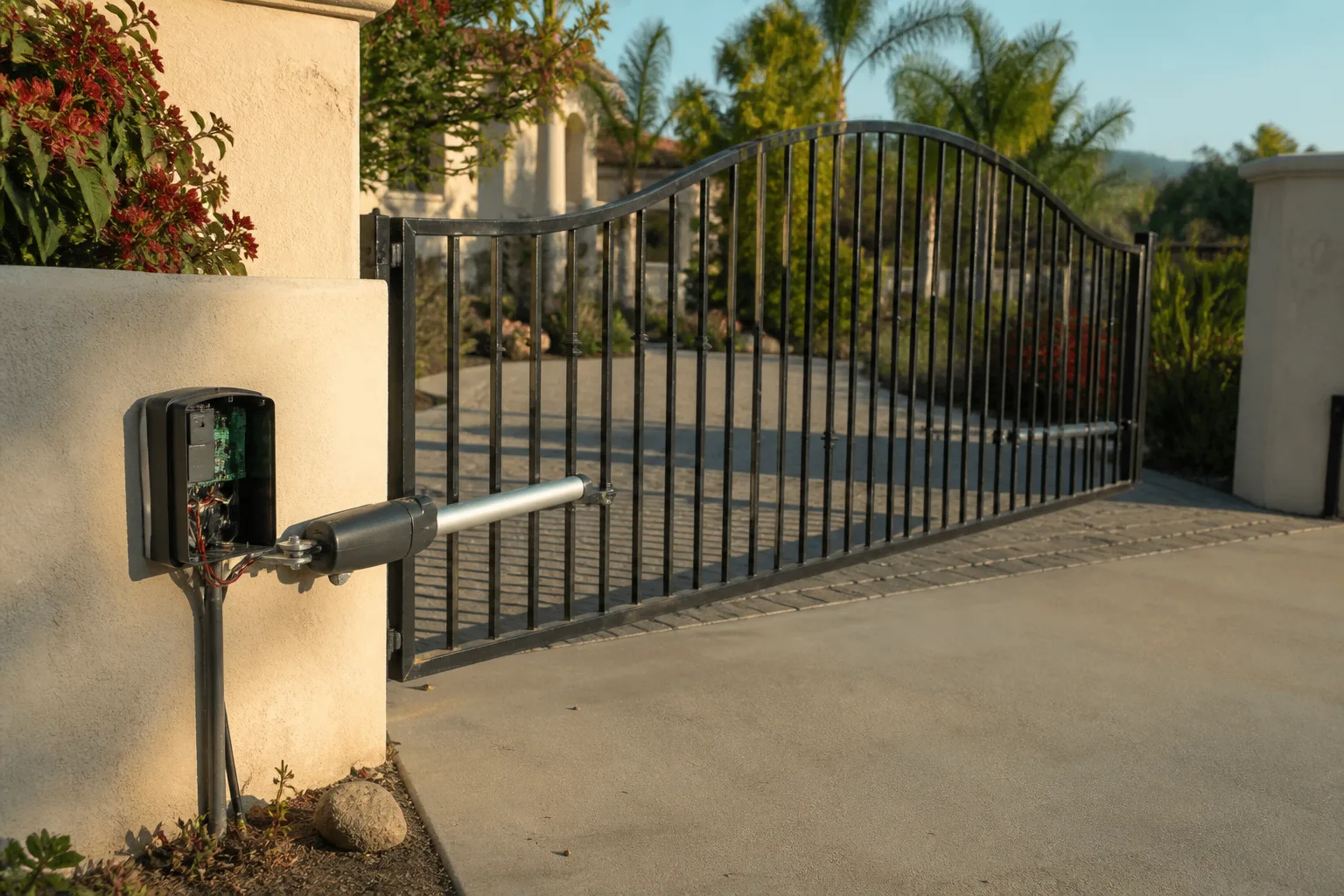
Ghost Controls builds solar-powered gate operators. That design choice changes everything about how they fail. An AC operator pulls constant voltage from your house; a Ghost Controls system charges a 12V battery from a solar panel, then the battery drives the actuator motor. When the gate moves slowly, reverses mid-travel, or beeps without moving, the problem often sits in the charging loop – the panel, the charge controller, or the battery itself – not in the motor.
Redlands gets plenty of sun most of the year, but the low winter sun angle cuts charging efficiency substantially. A panel that kept the battery topped up in July can fall short in December and January, especially if it faces north or gets shaded by a fence, a tree, or the house itself. The battery discharges a little more each cycle until the system’s low-voltage lockout kicks in. Homeowners call us convinced the gate is dead, and half the time the operator is fine and the charging system just needs attention.
The Voltage Test: What Your Battery Is Telling You
Before you suspect the motor, check the battery. A multimeter reading tells you more in thirty seconds than an hour of guesswork. Here’s what we look for:
- 12.6V to 13.4V – healthy, fully charged. If the gate won’t move at this voltage, the issue is programming, the actuator, or a wiring connection.
- 12.0V to 12.5V – partially discharged but should still operate briefly. If the gate struggles here, the charging system isn’t keeping up.
- 11.8V and below – low enough to trigger erratic behavior or lockout. This is where a perfectly good operator acts broken.
- 10.5V and below – the battery has been deeply discharged. It may recover with a slow charge, or it may need replacement.
Test voltage with the panel disconnected and the gate at rest, then test again while the gate is mid-cycle. A healthy battery holds voltage reasonably well under load; a tired one drops sharply. That drop is the difference between a recharge and a replacement. If any of this makes your eyes glaze over, call us – this is exactly the diagnostic work we do on electric gate repair calls all over Redlands.
Ghost Controls-Specific Failure Patterns
Every gate brand has its quirks, and Ghost Controls is no exception. After working on these systems across Redlands, certain patterns come up repeatedly. Recognizing them saves you time and us catch them faster:
Actuator arm grinding. The linear actuator that swings the gate relies on a threaded rod and internal gears. Dirt, worn grease, or a slightly misaligned mounting bracket causes a grinding or chattering sound. It’s usually repairable, but it needs attention before the gears strip. The torque spec on those mounting bolts matters more than you’d think – too tight or too loose changes the travel geometry.
Remote range degradation. Ghost Controls remotes use a receiver module that can lose sensitivity over time. If you have to hold the remote against the gate or point it at a specific angle, the issue could be the remote’s battery, but it could also be receiver drift, interference, or antenna damage. A new remote doesn’t fix a bad receiver.
Solar panel debris shading. In Redlands, dust and bird droppings build up on panels faster than people realize. A panel covered by even 30 percent loses significant charging output. The fix is simple – clean the panel and check for new shade sources – but it’s usually the last thing checked because the panel is out of sight line.
Winter Sun Angles and Why Redlands Gets Caught Off Guard
Redlands sits inland, in a desert-adjacent climate that fools people into thinking solar charging is a year-round given. It mostly is. But the winter sun angle drops enough that a panel mounted flat or facing slightly off-south loses meaningful charging efficiency from November through February. Add in one of those Redlands weeks of overcast, and a marginal battery gets pushed past its floor.
The fix isn’t always a bigger panel. Sometimes it’s repositioning the existing one to capture better winter sun, trimming a shrub that grew into the light path during the summer, or simply replacing an aging battery that can’t hold a charge the way it used to. Batteries in these systems typically last several years, but Redlands heat accelerates aging – summertime temperatures well past 100°F cook batteries slowly, and owners don’t notice until the first cool winter week when the gate starts moving sluggish. We’ve untangled plenty of these in Redlands; it’s almost never the actuator, and it’s almost always the charging loop.
Warranty vs. Wear-and-Tear: What You Need to Know
Ghost Controls offers warranty coverage on their operators, but the claim process requires documentation. Homeowners who registered their unit and kept the receipt have the fastest path. Warranty covers manufacturing defects – a failed motor out of the box, a bad control board, a receiver module that dies early. It does not cover environmental damage, battery replacement beyond the initial period, or problems caused by improper installation or voltage damage from a nearby lightning strike.
Before filing a claim, document everything: the model number, the date of purchase, the serial number, photos or video of the symptom, and a description of what the gate does when the issue occurs. If a contractor installed the system, their invoice may be needed to verify installation date. Wear-and-tear repairs – an actuator arm that has simply worn out, a battery past its useful life, a solar panel scratched by debris – are yours to handle. That’s where we come in. We work on the brand you already have, whether that’s Ghost Controls, Viking, DoorKing, or Elite, so a worn component doesn’t require it’s own odyssey.
Why This Repair Needs Different Tools and Torque Specs
Ghost Controls operators are belt-driven or direct-drive actuators – mechanically distinct from the chain-drive or screw-drive systems used on some commercial operators and from the mechanical hinges and closer springs on manual gates. A technician showing up with generic hand tools can swap a board, but they can’t properly adjust the actuator travel limits, calibrate the auto-close timing, or torque the mounting hardware without the right specifications.
Overtightening the actuator mount causes binding. Undertightening leads to bracket shift and stripped threads. The sensitivity settings on the obstacle detection system require calibration that matches the gate’s weight and travel distance – a setting that works on a six-foot light gate is wrong on a twelve-foot steel one. These are the details that separate a gate repair that holds from one that eats itself again in a month. If you’re in Redlands and your Ghost Controls system is doing something strange, we’d rather diagnose it correctly and be honest about what’s needed than sell you a part you don’t need. Gate repair in Redlands is what we do, and Ghost Controls is one of the systems we know cold.
When to Call a Pro
Some things are worth doing yourself: cleaning the solar panel, checking connections, even swapping a remote battery. But other things aren’t. If you hear grinding from the actuator, if the gate reverses at random, if the control board shows burn marks or smells overheated, if you’ve tested the battery and it reads fine but the gate still won’t move – stop and call us. Ghost Controls actuators are under mechanical load; a misadjusted arm can fail suddenly and a falling gate is heavier than most people expect. We schedule a proper diagnosis, quote the repair before any work begins, and get it back to secure in one visit.
For other gate systems around your property, we also handle Gate Repair Redlands services across the full spectrum – manual gates, electric operators, and new installations. And if you’re in Redlands with a gate that’s misbehaving, we cover the whole city, from the neighborhoods near downtown to the newer developments off the 10.
The Bottom Line
A Ghost Controls gate that stops moving is usually a power problem, not a motor problem. Check the battery voltage, clean the solar panel, and think about how much sunlight the panel has actually been getting – especially during Redlands’ shorter winter days. If the voltage is fine and the problem persists, the issue is mechanical or in the control system, and that’s where professional diagnosis earns its keep. Ghost Controls is a well-built system, but it needs the right approach: solar-first, then electrical, then mechanical.
If you’re in Redlands and need help with a Ghost Controls gate, Gate Repair Redlands offers free estimates – call (844) 405-5765. We answer 24/7. Fast dispatch from 7am to 7pm, Sunday through Friday.
Frequently Asked Questions
Cost depends entirely on what’s wrong. A battery replacement or solar panel service call is on the lower end; an actuator arm replacement or control board swap runs higher. The estimate is free, and we quote the price in writing before any work starts, so there are no surprises. Call (844) 405-5765 for an exact quote on your system.
In many cases, yes. If the problem is a battery, a connection, or a programming issue, we can typically resolve it in one visit. Fast dispatch runs from 7am to 7pm, Sunday through Friday. Call (844) 405-5765 and we’ll get you scheduled.
Intermittent operation almost always points to the charging loop. The battery gains enough charge during the day to run the gate a few times, then drops too low overnight or during cloudy stretches. Voltage testing will confirm it. We check the panel, the charge controller, and the battery before touching the motor. Call (844) 405-5765 and we’ll sort out which one it is.
Yes. We’re brand-agnostic – we service whatever operator is already on the property. Ghost Controls, Viking, DoorKing, Elite – we work on the brand you already have. If the system is under warranty, we’ll help you document the issue and advise you honestly on whether a claim or a repair makes more sense. Call (844) 405-5765 for a free estimate.
Written by the team at Gate Repair Redlands, serving Redlands since 2018.
Need Gate Repair Help?
Call Gate Repair Redlands - licensed & insured, here with fast help in Redlands.
(844) 405-5765